The sudden demise of veteran actor Nana Patekar at the age of 75 has left the Indian film industry and his countless admirers mourning the loss of one of cinema’s most distinctive performers. As tributes continue to pour in from across the country, Amul has joined the list with a special topical celebrating the legendary actor’s extraordinary contribution to Hindi and Marathi cinema.
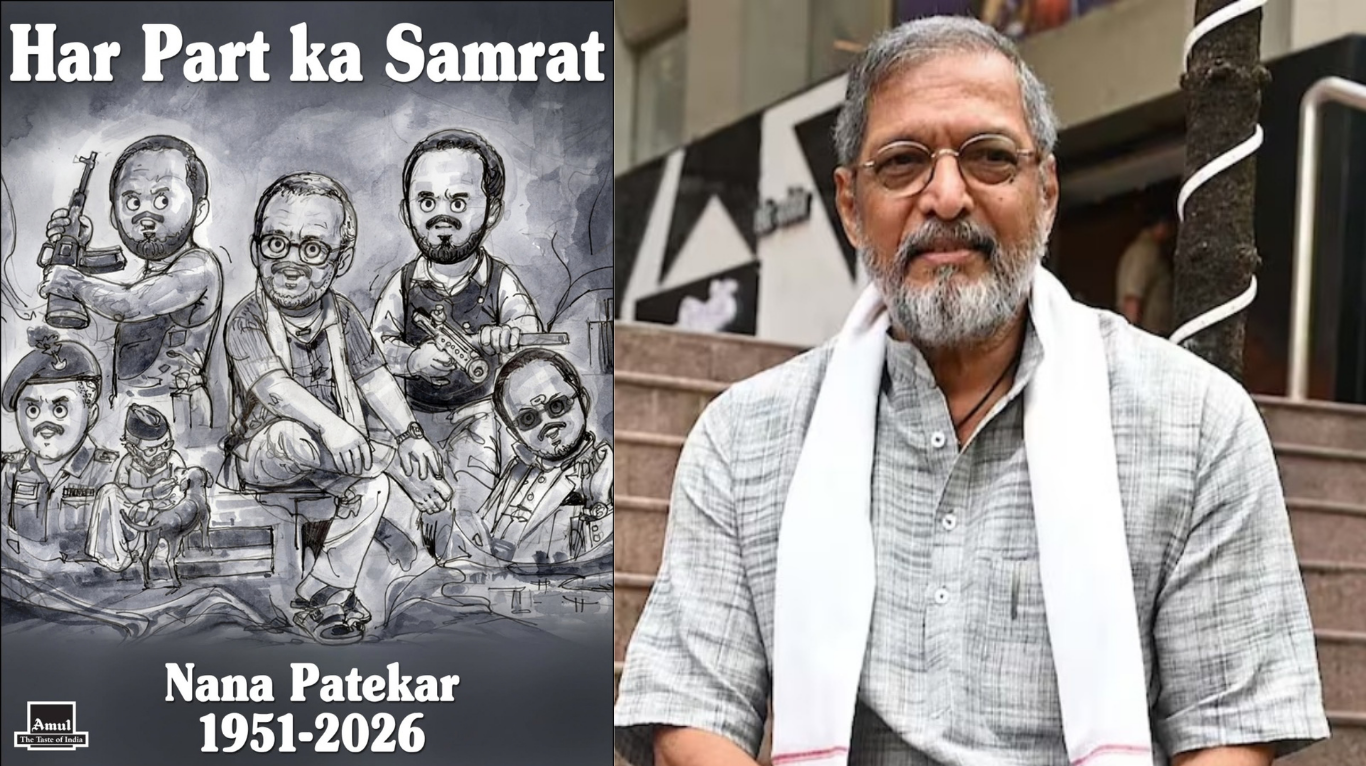
Known for creating topical advertisements around major cultural moments and personalities, Amul remembered Nana Patekar with a striking black-and-white illustration accompanied by the phrase “Har Part Ka Samrat.” The creative is a clever reference to Patekar’s celebrated performance in the Marathi film Natsamrat while also highlighting his ability to completely own the diverse characters he portrayed throughout his career.
Amul’s Special Tribute to Nana Patekar
Amul’s tribute captures several different facets of Nana Patekar’s screen persona. Rather than focusing on one particular role, the artwork brings together multiple looks associated with the actor’s long and varied career.
The tagline “Har Part Ka Samrat” carries a special significance. Nana Patekar was not an actor who was easily confined to one genre or type of character. Over the years, he moved comfortably between intense dramas, action-oriented films, social stories, comedy and Marathi cinema.
The reference to Natsamrat is particularly meaningful because the 2016 Marathi film became one of the defining performances of his later career. Patekar played the central character with the emotional intensity and theatrical depth that had become synonymous with his acting style.
At the bottom of Amul’s artwork, the dates “Nana Patekar 1951–2026” appear as a simple marker of the actor’s life and legacy. Amul shared the creative on its social media page with a message describing it as a tribute to the “legendary and much loved actor.”
Why ‘Har Part Ka Samrat’ Is a Fitting Tribute
Nana Patekar’s career was defined by his ability to make even complicated characters feel authentic. His voice, facial expressions, dialogue delivery and intense screen presence gave his performances a recognisable identity.
The word “Samrat” in Amul’s creative is naturally associated with Natsamrat, but the phrase also reflects how audiences viewed Patekar across several decades.
From serious and socially relevant characters to memorable comic performances, the actor repeatedly demonstrated his versatility. His portrayal of Uday Shetty in Welcome, for instance, introduced a different side of his personality to a younger generation of viewers. The character’s comic timing and memorable exchanges with other characters eventually became part of popular internet culture.
His serious performances, meanwhile, established him as one of the most powerful actors of his generation.
That contrast is precisely what makes the Amul topical effective. In just a few words and a simple visual, it celebrates both the actor’s theatrical legacy and his enormous popularity among mainstream audiences.
Nana Patekar’s Five-Decade Cinematic Journey
Nana Patekar, born Vishwanath Gajanan Patekar, built a career spanning nearly five decades. He made his film debut in the late 1970s and gradually established himself as a performer capable of handling challenging and unconventional roles.
His work in films such as Parinda and Krantiveer earned him widespread recognition. He was also associated with Indian parallel cinema and projects that dealt with serious social themes.
His performances were often marked by an intensity that made even relatively quiet scenes memorable. Patekar did not depend solely on elaborate dialogue or conventional heroism. His acting frequently relied on pauses, expressions and an unmistakable voice.
He also became one of the few performers to achieve recognition across both Hindi and Marathi cinema.
His performance in Natsamrat remains particularly important to his legacy. The film allowed him to combine his theatre background with the emotional demands of a deeply layered character, earning widespread appreciation.
Beyond acting, Patekar also worked as a director and writer and remained associated with social causes.
Nana Patekar’s Death Leaves Bollywood in Shock
Nana Patekar died on October 8, 2026, at the age of 75. According to reports, he was found unconscious at his residence in Goa and was taken for medical treatment. Reports have indicated a suspected cardiac arrest, although details surrounding the exact medical cause have been reported with some variation.
News of his death prompted an immediate wave of reactions from the entertainment industry, political leaders and fans.
Prime Minister Narendra Modi remembered Patekar for his distinctive presence, versatility and contribution to Hindi and Marathi cinema, saying that his passing had left a deep void.
Maharashtra Chief Minister Devendra Fadnavis also paid tribute to the actor, recalling his contribution to Marathi and Hindi cinema and remembering his association with social causes.
The widespread response demonstrates the unique position Patekar occupied in Indian popular culture. He was simultaneously recognised as an acclaimed performer, a theatre-trained actor, a filmmaker and a personality known for speaking his mind.
From Intense Drama to Comedy, Nana Patekar Had Many Faces
One of the most remarkable aspects of Nana Patekar’s legacy is the sheer variety of characters he played.
His filmography includes characters that demanded emotional restraint, anger, vulnerability, humour and authority. His portrayal of Uday Shetty in Welcome became especially popular with audiences and later generations through memes and social media clips.
Several of his dialogues and scenes have continued to circulate online years after their original release. Moneycontrol recently highlighted how moments from his films became part of meme culture, showing how his performances continued to remain relevant beyond the traditional cinema audience.
This ability to remain culturally relevant across generations is perhaps one of the strongest signs of his impact.
Amul’s Topical Adds to a Growing Wave of Tributes
Amul has a long-standing tradition of using topical advertisements to acknowledge major cultural moments. Its Nana Patekar tribute follows the same familiar approach: a simple illustration, a short wordplay-driven headline and a visual connection to the personality being remembered.
In this case, “Har Part Ka Samrat” works on multiple levels.
It recalls Natsamrat, acknowledges Nana Patekar’s command over different characters and serves as a respectful farewell to an actor whose career was built around memorable performances.
The simplicity of the creative also mirrors the tone of many tributes being shared after his death. Rather than focusing on a single film, it celebrates the actor’s overall body of work.
Nana Patekar’s Legacy Will Live On
The loss of Nana Patekar marks the end of an important chapter in Indian cinema. While his death has brought grief to his family, colleagues and fans, his body of work ensures that his presence will continue to be felt.
For audiences, Nana Patekar will remain associated with powerful performances, unforgettable characters and a voice that could instantly command attention.
Amul’s “Har Part Ka Samrat” tribute captures that legacy in a concise but meaningful way. It reminds viewers that Nana Patekar was not simply the face of one iconic role. He was an actor who repeatedly transformed himself for the character in front of him.
As the film industry continues to remember the veteran performer, his films, dialogues and characters are likely to remain part of Indian popular culture for years to come.
For an actor whose career was defined by unforgettable parts, Amul’s message is a fitting final salute: Nana Patekar was truly a Samrat in every part he played.