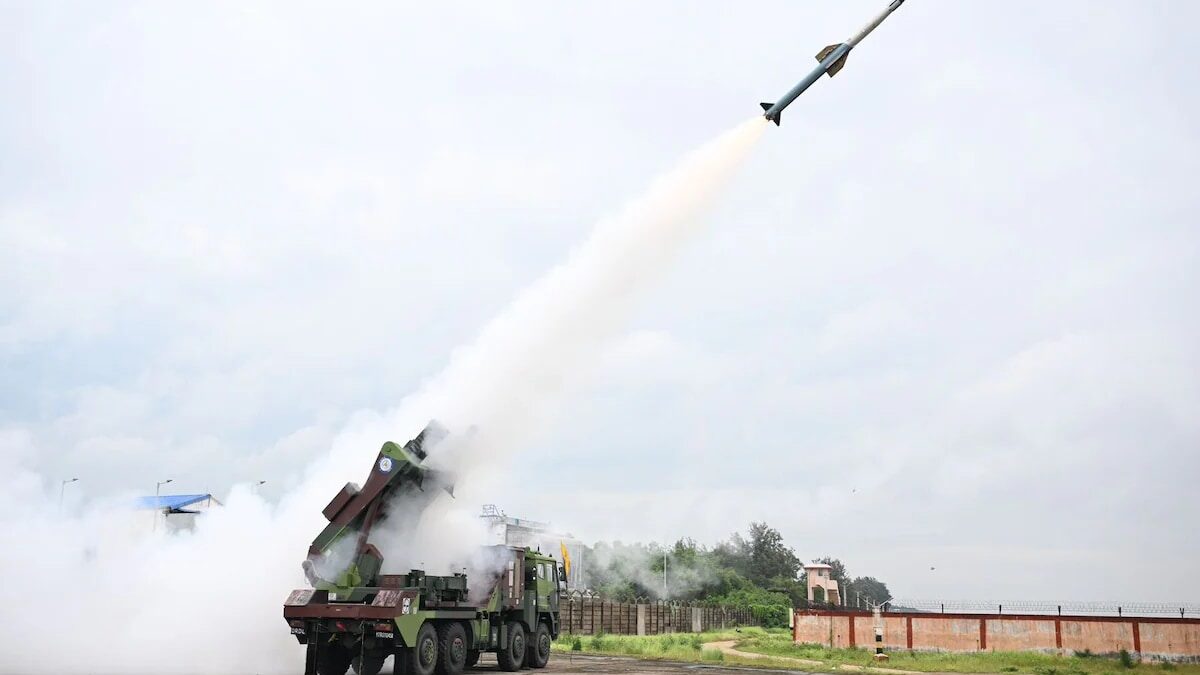
In a major boost to India’s indigenous defence capabilities, the Defence Research and Development Organisation (DRDO) announced the successful maiden flight test of the Integrated Air Defence Weapon System (IADWS). Conducted at a secure testing facility, this achievement has placed India among a select group of nations capable of developing advanced, multi-layered air defence systems.
The test comes at a time when air defence has become crucial in modern warfare, especially with the rising threats of drones, missiles, and stealth aircraft.
What is the Integrated Air Defence Weapon System?
The IADWS is a cutting-edge defence system designed to intercept, track, and neutralise aerial threats ranging from:
- Fighter jets
- Cruise missiles
- Unmanned Aerial Vehicles (UAVs)
- Precision-guided munitions
The system integrates radars, missile launchers, command control centres, and tracking units, ensuring a 360-degree protective shield for critical defence assets and cities.
Details of the Maiden Flight Test
During the test, the IADWS was launched against a simulated aerial target. Defence officials confirmed that the system:
- Successfully detected and tracked the target in real-time
- Engaged and neutralised the aerial threat with high accuracy
- Demonstrated seamless coordination between radars, control units, and missiles
Officials praised the weapon system for its reliability, precision, and rapid response capability—critical in modern battlefield scenarios.
Why This Test Matters for India
- Strengthens Self-Reliance (Atmanirbhar Bharat): The system has been developed indigenously, reducing India’s dependence on foreign defence imports.
- Multi-Layered Security: Adds another shield to India’s already growing air defence ecosystem, which includes Akash, Barak-8, and the S-400 Triumf systems.
- Strategic Advantage: Protects not only military installations but also key cities, industrial hubs, and strategic assets.
- Boost for Exports: Once fully developed, India could offer this system to friendly nations, enhancing its role as a global defence supplier.
Official Statements
A senior DRDO scientist hailed the test as a “turning point in India’s air defence preparedness”, saying:
“The Integrated Air Defence Weapon System will provide India with a layered protection mechanism against a wide variety of aerial threats. Today’s successful flight has proven our capabilities.”
Defence Minister Rajnath Singh congratulated DRDO scientists, tweeting:
“This achievement showcases India’s technological prowess and commitment towards building a self-reliant defence ecosystem.”
Global Implications
India’s success with IADWS puts it in league with global defence leaders like the US (Patriot missile systems), Russia (S-400, S-500), and Israel (Iron Dome). With increasing geopolitical tensions, this achievement highlights India’s preparedness to safeguard its skies from any hostile intrusion.
What’s Next?
The maiden flight is just the beginning. Multiple phases of testing—including night trials, high-altitude tests, and live combat simulations—will follow. Once fully operational, the system will be deployed in strategic zones across India, offering unmatched air defence protection.
Key Takeaways
- India successfully conducted the maiden flight of its Integrated Air Defence Weapon System.
- The system neutralised aerial threats with precision and accuracy.
- Strengthens Atmanirbhar Bharat initiative and reduces reliance on imports.
- Positions India as a future global supplier of advanced air defence systems.
Also Read:
Govinda’s Lawyer Finally Breaks Silence on Divorce Rumours with Sunita Ahuja